
A composite door is an external door built from several materials bonded together, usually a solid timber or foam core faced with glass-reinforced plastic (GRP) skins, set in a uPVC or aluminium frame. It looks like painted timber but resists warping, fading and rot, insulates well and takes a multi-point lock. Most are made to order in your choice of colour, glass and hardware.
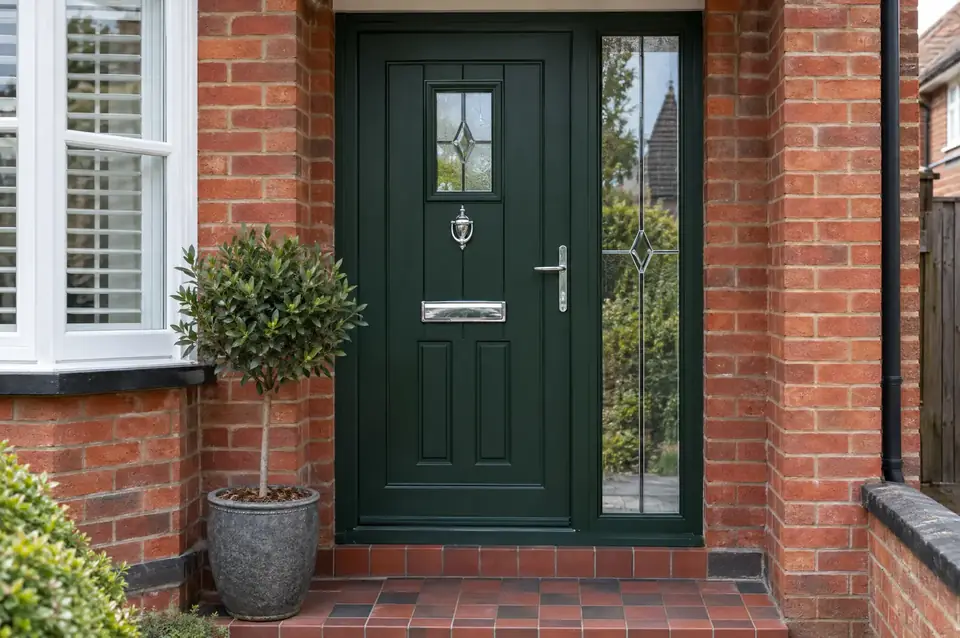
Your front door takes more knocks than any other part of the house: slammed shut hundreds of times a year, rained on, bleached by the sun and tested by anyone who wants to get in. Older uPVC panel doors tend to drop, leak around the seals and lose their lock alignment. A composite door is thicker and heavier, so it feels solid, holds its shape and closes against a proper seal.
Composite doors suit almost any house, from terraces opening straight onto the pavement to semis with porches and side panels. You choose the style, the colour (inside and outside can differ), the glass, letter plate and handles. Back and side doors can be made the same way, often in a plainer design with a half-glazed panel to let light into a kitchen or utility room.
Which options suit your home?
Solid front door
A fully solid slab with no glass gives the most privacy and the best insulation. It suits halls that already get light from a side panel or fanlight. Many styles add raised or flat moulded panels, so a solid door needn't look plain, and a spy hole or door chain can be added for checking callers.
Part-glazed or half-glazed door
Glass in the top half or a narrow strip lets daylight into a dark hallway. Door glass must be safety glass up to 1,500 mm from the floor, and you can choose obscure, textured or decorative glass for privacy. If more than half of the door face is glass, the installation must be certified under the Building Regulations.
Door with side panels or top light
Side panels and fanlights make a wider, brighter entrance and are often found on 1930s and post-war semis. They're made as one frame with the door, usually in matching glass. A wider frame costs more, and glass in panels close to the door must be safety glass under Approved Document K.
Back and side doors
Composite back doors use the same construction as front doors, typically in a simpler panel style. They're a good swap for a tired uPVC kitchen or utility door that has dropped or lets in draughts. A low threshold can be specified where a step makes access difficult, though it needs careful detailing to keep rain out.
Security upgrades
Doors can be specified with anti-snap cylinders, multi-point locking, hinge-side protection and laminated glass. Some doorsets are tested to the PAS 24 enhanced security standard or carry Secured by Design status. If that matters to your insurer, ask for it at survey and it will be named in your specification.
What's included when SKJ does the work?
- Free survey and measure, including a check of the opening, lintel and threshold
- Made-to-measure composite door and frame in your chosen colour, glass and hardware
- Removal and disposal of the old door and frame
- Fitting with proper fixings, packers and weather seals, and a threshold set to suit the floor
- Adjustment of hinges and the multi-point lock so the door closes evenly
- Making good inside and out with trims and silicone
- Building regulations certification where the door is more than half glazed
- Manufacturer's guarantee paperwork, with the terms set out in your quote
How much does a composite door cost?
Guide prices run from £900 to £3,400 per door. Composite front door in a standard frame, no side panels, colour of your choice: typically £1,100 – £1,700 per door.
| Option | Guide price | Good to know |
|---|---|---|
| Back or side door | £900 – £1,350 per door | Simple panel style, solid or half-glazed |
| Front door, standard frame | £1,100 – £1,750 per door | Wide choice of styles, colours and glass |
| Front door with side panels | £1,800 – £3,400 per door | One or two side panels and/or a top light |
Usually included: Survey and measure, door and frame made to order, multi-point lock and cylinder, standard door furniture, removal of the old door, fitting, making good at the reveal and certification where required.
Usually extra: Rebuilding steps or forming new openings, structural lintel replacement, decorating the hallway, smart locks, and planning or listed building consent fees where needed.
Guide ranges are the total a homeowner would expect to pay, including VAT where it applies. Your fixed price comes after a free survey.
What changes the price?
- Door style and how much of it is glazed
- Side panels, a top light or a wider-than-standard frame
- Colour, including different colours inside and out
- Hardware upgrades such as anti-snap cylinders, knockers, letter plates and numerals
- Threshold changes for level or low-step access
- Repairs to the opening, such as a cracked lintel or uneven step
How does the job run, start to finish?
- Survey and designWe measure the opening, check the brickwork, lintel and step, and talk through styles, glass, colour and hardware. If your hall is dark or the step is awkward, we'll suggest options such as a glazed panel or a lower threshold.
- Quote and orderYour written quote lists the exact door, frame, glass, lock, letter plate and handles. Once you approve it, the door is made to order, which usually takes four to six weeks for most colours and styles.
- Fitting dayWe take out the old door and frame, check the opening is square and sound, and fit the new frame on packers with proper fixings. The door is hung, the lock set up and the threshold sealed against rain.
- Adjusting and finishingHinges and keeps are adjusted so the door closes without slamming or needing a hard lift of the handle. Trims and silicone are finished inside and out, and any plaster at the reveal is made good.
- HandoverWe show you how the lock and handle work, hand over every key, and leave the guarantee and any certification paperwork. Keep the spare keys somewhere safe, because cylinders are supplied with a set number of keys.
Timescale: Fitting takes half a day to a day, once the door has been made (usually 4–6 weeks).
Planning, Building Regulations and approvals
Does a new front door need building regulations approval?
A replacement external door and frame must meet the energy limits in Approved Document L: a U-value of 1.4 W/m²K, or a Doorset Energy Rating of band B (band C where more than 60% of the door face is glazed). Under Schedule 4 of the Building Regulations, a door and frame with no more than 50% glazing doesn't need a building notice, although it must still comply. A more heavily glazed door must be certified, either by a competent person scheme installer or through building control.
What other rules apply to a replacement door?
Under Approved Document K, glass in a door, and in side panels within 300 mm of the door edge, must be safety glass up to 1,500 mm above the floor. If your home has a level threshold, which is common in houses built since 1999, the new door should keep it. Planning permission isn't usually needed for a similar-looking door on a house, but listed buildings, flats and some conservation areas have extra controls.
Composite doors: your questions answered
How much does a composite front door cost?
A standard composite front door, supplied and fitted in an existing opening, typically costs around £1,100–£1,750 in the West Midlands. Adding side panels or a top light usually takes the total to £1,800–£3,400, depending on width and glass. Your quote lists the door, frame, glass and hardware separately, so you can see what each choice adds.
How long does it take to fit a composite door?
Fitting itself normally takes half a day to a full day, depending on whether side panels are included and how much making good is needed. Most of the wait is manufacture, which is usually around four to six weeks after you approve the design. You'll have a working, lockable door at the end of fitting day.
Will I be without a front door for long?
No. The old door stays in until the new one is on site, and we remove and fit in the same visit. The opening is only empty for a short time while the frame goes in, and the door is hung and locked before we leave. If anything unexpected turns up in the opening, we'll make it secure before going.
Are composite doors more secure than uPVC doors?
Composite doors are generally thicker and stiffer than uPVC panel doors, which makes them harder to force, but the lock and cylinder matter most. Ask for an anti-snap cylinder and a multi-point lock, and consider a doorset tested to PAS 24 if your insurer asks. Every security option is named in your specification, so you know exactly what's fitted.
What guarantee comes with a composite door?
The door, frame, glass and hardware are covered by the manufacturer's guarantee, and the exact terms for your door are set out in your quote. Guarantees often treat colour fading, sealed units and locks differently, so it's worth reading those lines. Keep the paperwork with any certification for when you sell.
Can I keep my existing frame and just change the door?
Sometimes, but it's rarely worth it. Composite doors are made as a matched doorset, with the frame, hinges and lock keeps built around the slab, so fitting a new slab into an old uPVC frame seldom seals or locks as well. We'll tell you at survey if your frame is sound enough, but most jobs replace both.
Which areas do we cover for composite doors?
We cover the whole West Midlands from West Bromwich. Pick your area for local details, councils and postcodes: