
A patio is a paved area in the garden, usually next to the house, laid on a compacted stone sub-base and bedded in mortar. Common materials are porcelain, natural stone such as Indian sandstone, limestone or slate, and concrete flags. A well-built patio falls gently away from the house, sits below the damp-proof course and drains without puddles.
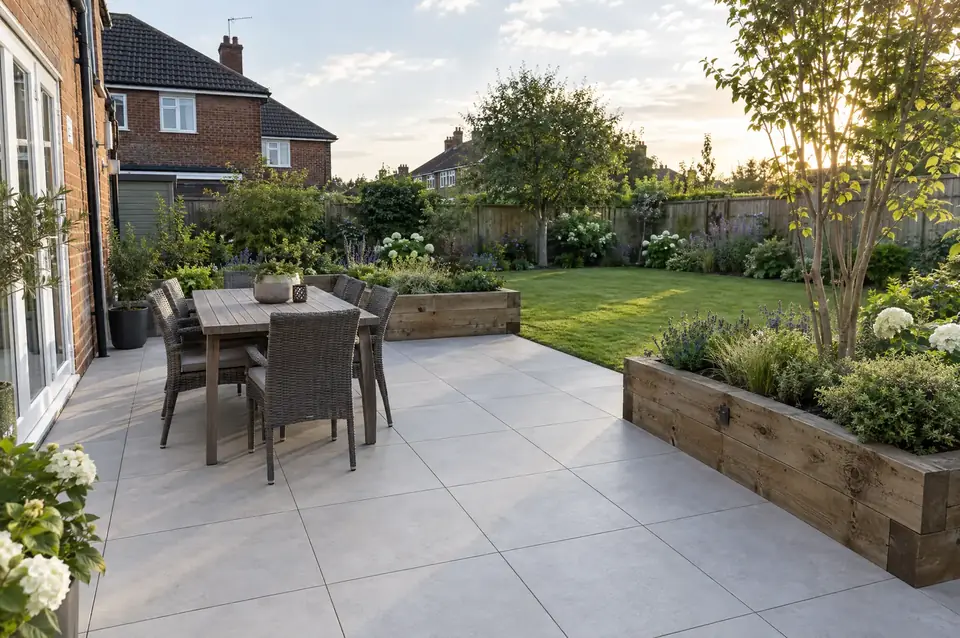
A good patio gives you somewhere to sit, eat and dry washing without walking on wet grass, and it should look as good in ten years as it does in the first summer. Most patio problems come from shortcuts: slabs spot-bedded on dabs of mortar, no sub-base, or a patio laid tight against the house above the damp-proof course. We build ours from the ground up, with a full bed under every slab.
Material choice affects both the look and the work involved. Porcelain is hard-wearing and easy to clean but needs a special primer and careful cutting. Natural sandstone has variation in every slab and a softer, traditional feel. Concrete flags cost least and come in many colours. We bring samples to the survey so you can see them in your own garden light.
Which options suit your home?
Porcelain paving
Thin, dense tiles made for outdoor use, with very low water absorption, so they resist staining, moss and fading. Porcelain needs a bonding primer on the back of each slab and a full mortar bed, because ordinary mortar won't stick to it. It's precise to cut and lay, which shows in the price, but it's easy to keep clean.
Indian sandstone
A natural stone in buff, grey, brown and mixed tones, with either a riven, textured surface or a smooth sawn finish. Every slab is slightly different, giving a traditional look. Sandstone is more porous than porcelain, so it can weather and pick up algae, and many people seal it after laying to make cleaning easier.
Limestone and slate
Limestone gives a soft, even colour, usually in grey, blue-black or buff, while slate is dark, fine-grained and often used for contemporary gardens. Both are natural stones with their own character and cost a little more than sandstone. Slate can be slippery when wet in shaded spots, so we'll talk about texture and position before you choose.
Concrete flags
Cast concrete slabs, smooth or textured, in a wide range of sizes and colours. Concrete flags are the most affordable patio material and are quick to lay. They're heavier and thicker than porcelain, suit low-budget projects or larger areas, and can look very tidy in a simple pattern with neat joints.
Steps, edging and low walls
Most gardens aren't flat, so patios often need a step down to the lawn, a low retaining wall or a raised planter. Steps should have even risers and a firm edge, and retaining walls need proper foundations. These details are priced separately in your quote so you can see what the paving alone costs.
What's included when SKJ does the work?
- Free survey, including levels, the damp-proof course, air bricks and drains near the house
- Layout and pattern agreed with you, with samples to compare
- Excavation and removal of turf, soil or an old patio
- Compacted stone sub-base to a depth that suits the ground
- Full mortar bed under every slab, with a bonding primer for porcelain
- Falls set away from the house, with a drainage channel where levels are tight
- Pointing or brush-in jointing compound to finish the joints
- Clean-down of the finished patio and removal of all waste
How much does a patio cost?
Guide prices run from £90 to £230 per m². Indian sandstone on a full sub-base and mortar bed, including dig-out and waste: typically £120 – £170 per m².
| Option | Guide price | Good to know |
|---|---|---|
| Concrete flags | £90 – £130 per m² | Lowest cost, wide range of colours |
| Indian sandstone | £120 – £175 per m² | Natural riven or sawn finish |
| Porcelain paving | £140 – £230 per m² | Low maintenance, primed and fully bedded |
Usually included: Survey, excavation and waste removal, sub-base, full mortar bed, paving, primer for porcelain, jointing, falls and clean-down.
Usually extra: Steps, retaining walls and raised planters (priced separately), drainage channels or soakaways unless quoted, lighting, removal of large concrete bases, and sealing natural stone.
Guide ranges are the total a homeowner would expect to pay, including VAT where it applies. Your fixed price comes after a free survey.
What changes the price?
- Patio size and shape, including curves and circles
- Material: concrete flags, natural stone or porcelain
- Dig-out depth and removal of an old patio or concrete
- Steps, retaining walls and changes in level
- Drainage near the house, such as a channel drain
- Access, especially if everything has to go through the house
How does the job run, start to finish?
- Survey and chooseWe measure the area, take levels from the damp-proof course and air bricks, and look at how water drains now. You'll see material samples and talk through size, pattern, steps and edging before we quote.
- Set out and digThe patio is pegged out with string lines to the agreed size and falls. Turf, soil or the old patio is dug out and taken away, and any soft ground is dug deeper and filled with stone.
- Sub-baseA compacted stone sub-base is laid and wacked in layers to give a firm, even platform. This is the step that stops slabs rocking or sinking later, so it's done properly even though you won't see it.
- Lay the pavingEach slab goes onto a full mortar bed, primed first if it's porcelain, and is tapped down to line and level. Cuts are made cleanly at edges and around manholes, and falls are checked as we go.
- Joint, clean and hand overOnce the bed has set, joints are pointed or filled with jointing compound. The patio is cleaned, the edges are tidied and waste is removed. We'll tell you when it's ready for furniture and foot traffic.
Timescale: Usually 3–6 days on site for a 15–25 m² patio, longer with steps or walls.
Planning, Building Regulations and approvals
Do I need planning permission for a patio?
Usually not for a back garden. Hard surfaces behind the house are normally permitted development. In front gardens, the 5 m² rule applies: more than that in impermeable paving that doesn't drain onto your own land needs permission. A patio or platform raised more than 0.3 m above the ground isn't permitted development and needs planning permission. Listed buildings, flats and areas under an Article 4 direction have extra controls.
How should a patio sit against the house?
A patio next to the house should finish at least 150 mm below the damp-proof course, so rain splashing off it doesn't bridge the damp protection and cause damp inside. It must never cover air bricks, which ventilate suspended timber floors. The paving should fall gently away from the house, typically around 1:60 to 1:80, and where levels are tight a channel drain is used to collect water at the wall.
Patios: your questions answered
How much does a new patio cost?
In the West Midlands, patios usually cost around £90–£130 per m² in concrete flags, £120–£175 per m² in Indian sandstone and £140–£230 per m² in porcelain, laid on a full sub-base with waste removal. A 20 m² sandstone patio therefore typically costs about £2,400–£3,500. Steps, walls and drainage are priced as extra lines.
How long does it take to lay a patio?
A 15–25 m² patio usually takes three to six days, including dig-out, sub-base, laying and jointing. Steps, walls or awkward access add time. Mortar needs a few days to harden before heavy furniture or barbecues go on it, and we'll give you a clear date.
Porcelain or natural stone: which should I choose?
Porcelain is the easiest to keep clean, resists stains and moss, and gives a consistent colour. Natural stone has more variation and character, feels softer underfoot and costs a little less, but it's more porous and benefits from sealing. Many people choose porcelain for a contemporary look and sandstone for a traditional garden.
Can a new patio go on top of my old one?
Rarely. Laying over an old patio raises the level, which can bring it too close to the damp-proof course, and any movement in the old slabs will carry through. We usually lift the old paving and check the base underneath. If it's sound and the levels allow, we'll say so at survey.
What guarantee do I get on a new patio?
Paving materials come with their manufacturers' guarantees, and the terms for your patio are set out in your quote. Natural stone varies by nature, so colour and texture differences between slabs are normal rather than faults. Ask us anything about the specification before you sign.
What do I need to do before the work starts?
Clear the area of pots, furniture and anything you want to keep, and lift any plants you'd like to move. If access is through the house, clear a path from the front door to the back. Let neighbours know about the skip and some noise while we dig and cut.
Which areas do we cover for patios?
We cover the whole West Midlands from West Bromwich. Pick your area for local details, councils and postcodes: