
A driveway is a hard-surfaced parking area, usually in front of the house, built on a dug-out and compacted sub-base. The common surfaces are block paving, tarmac, resin-bound stone and gravel. A new driveway often also needs edging, drainage and, if you don't already have one, a dropped kerb so you can legally drive across the pavement.
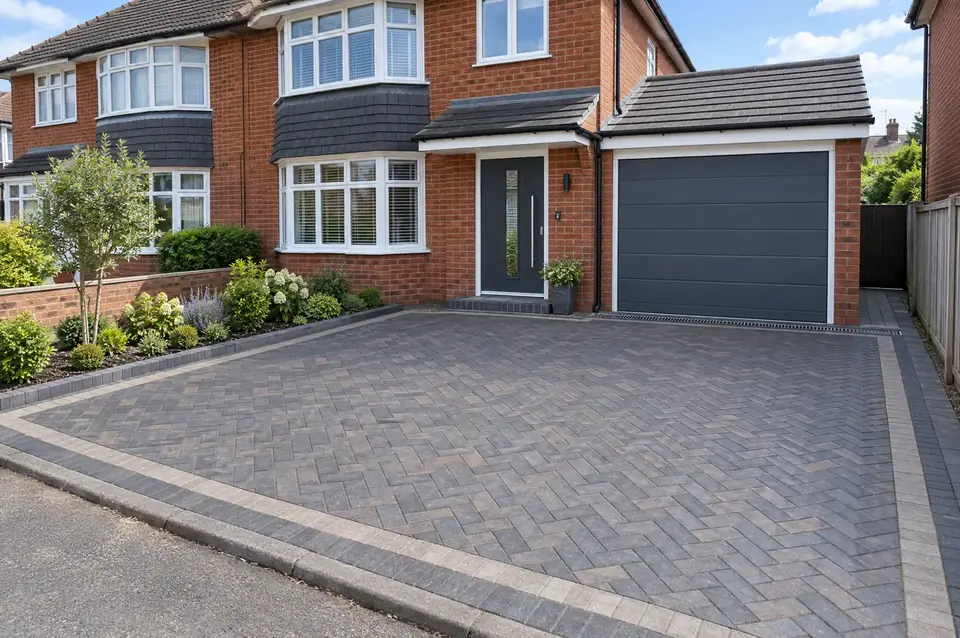
The part of a driveway you see is only the top few centimetres. What decides whether it stays flat or sinks, cracks and puddles is underneath: how deep it's dug, the stone sub-base, how well that's compacted, and where the rainwater goes. We dig out to suit the ground and the surface, and we plan the drainage before the first block or stone goes down.
Most front driveways in England also have to follow two sets of rules. If you're paving more than 5 m² of a front garden, the surface needs to be permeable or drain to a lawn, border or soakaway on your land, otherwise you'll need planning permission. And if you don't already have a dropped kerb, you'll need the council's consent to cross the pavement. We'll check both at survey.
Which options suit your home?
Block paving
Concrete blocks laid in a pattern on a sand bed over a compacted stone sub-base, held in by edging kerbs. Blocks come in many colours and sizes, and single blocks can be lifted and relaid if a drain needs work. Standard block paving needs drainage planning, because the sand joints alone don't usually let enough water through.
Permeable block paving
Blocks with wider joints filled with grit, laid on an open-graded stone sub-base that stores rainwater and lets it soak into the ground. Permeable paving meets the front garden rules without planning permission. It costs a little more because of the deeper, specially graded sub-base, and it suits clay soils only with extra design.
Tarmac
Hot-laid asphalt over a compacted sub-base, finished with a roller and edged with kerbs or setts. Tarmac is quick to lay and good value for larger areas. Standard tarmac is impermeable, so on a front garden it needs to drain to a soakaway or border, or use a porous asphalt mix.
Resin-bound surfacing
Natural aggregate mixed with clear resin and trowelled smooth, giving a tidy, loose-free finish. Resin-bound is permeable only if it's laid on a permeable base such as porous asphalt; laid over solid concrete it isn't. It shouldn't be confused with resin-bonded, where stones are scattered onto a resin coat, which isn't permeable at all.
Gravel with ground grids
Gravel laid over plastic ground grids on a membrane and compacted sub-base. The grids stop the gravel moving into ruts, and the whole surface drains naturally, so it meets the front garden rules. Gravel is the most affordable surface, though it needs occasional raking and topping up, and it's less practical for wheelchairs and pushchairs.
What's included when SKJ does the work?
- Free survey, including levels, existing drains, manholes and the boundary with the pavement
- Layout drawing showing parking spaces, edging and where rainwater will go
- Excavation and removal of soil, old paving and waste
- Geotextile membrane and a compacted sub-base suited to the chosen surface
- Edging kerbs or setts to hold the surface in place
- Channel drains, soakaways or permeable construction so water stays off the road
- Manhole covers raised, lowered or replaced with recessed trays to match the new level
- Advice on the dropped kerb application, with the council's own works charged separately
How much does a driveway cost?
Guide prices run from £2,200 to £12,000 depending on size and specification. Block paving driveway of about 45 m² for two cars, with dig-out, sub-base, edging and drainage: typically £5,000 – £7,200.
| Option | Guide price | Good to know |
|---|---|---|
| Gravel or tarmac driveway | £2,200 – £4,800 | About 40 m², new sub-base and edging |
| Block paving driveway | £4,500 – £7,500 | About 40–50 m², with drainage or permeable build |
| Resin-bound driveway | £5,000 – £8,500 | About 40–50 m², on a permeable base |
Usually included: Survey and layout, excavation and waste removal, membrane, sub-base, edging, the chosen surface, drainage detailed in the quote and adjustment of manhole covers.
Usually extra: The council's dropped kerb fees and highway works, planning fees if an application is needed, walls, gates and lighting unless quoted, and repairs to existing drains found during the dig.
Guide ranges are the total a homeowner would expect to pay, including VAT where it applies. Your fixed price comes after a free survey.
What changes the price?
- Area of the driveway and the number of cars it needs to hold
- Surface choice: gravel, tarmac, block paving or resin-bound
- Depth of dig-out and amount of soil or old concrete to remove
- Drainage required, such as channel drains or a soakaway
- Steps, walls, slopes and manholes to work around
- Access for diggers, skips and grab lorries
How does the job run, start to finish?
- Survey and levelsWe measure the area, take levels from the house to the pavement, and locate drains, manholes, meters and buried services. We check the damp-proof course, because the new surface must finish well below it, and look at how water currently runs off.
- Design and quoteYou get a layout and written quote naming the surface, the sub-base depth, edging and drainage. If you need a dropped kerb, we explain how the council's application works and what they're likely to need from you.
- ExcavationThe old surface and soil are dug out to the required depth and taken away. Excavation depth depends on the ground and the surface, and soft spots are dug out further and filled with stone.
- Sub-base and drainageA geotextile membrane goes down, followed by the stone sub-base, compacted in layers. Channel drains, soakaways and edging kerbs are installed at this stage, and manholes are adjusted to the new level.
- Surface layingThe blocks, tarmac, resin or gravel are laid to the agreed pattern and falls. Block paving is cut in at the edges, jointed and compacted; tarmac is rolled; resin is trowelled and left to cure.
- Finish and handoverWe clean the surface, check falls with water and tidy the borders. We'll tell you when you can walk and drive on it, which can mean waiting a day or two for resin and fresh tarmac.
Timescale: Usually 3–7 days on site for a typical front driveway, plus curing time for resin or tarmac.
Planning, Building Regulations and approvals
Do I need planning permission for a new driveway?
Not if it's built the right way. For houses in England, paving more than 5 m² of front garden needs planning permission only if the surface is impermeable and the water doesn't drain to a lawn, border, rain garden or soakaway within your property. Permeable block paving, porous asphalt, gravel and resin-bound on a permeable base don't need permission. Flats and maisonettes don't have these rights, and listed buildings or Article 4 directions can add controls.
Do I need permission for a dropped kerb?
Yes. You need consent from the highway authority, which is usually your local council, before you can drive across the pavement, and driving over a full-height kerb isn't allowed. The council inspects the site and may refuse if trees, street furniture, visibility or the size of your driveway make it unsafe. Many councils only let their own approved contractors build the crossing. Planning permission is usually also needed if your house is on a classified (A, B or C) road.
Where does the rainwater have to go?
Water from a new driveway should stay on your land rather than running onto the pavement or road. That usually means a permeable surface, a channel drain at the boundary feeding a soakaway, or falls towards a lawn or border. Connecting a driveway to a public sewer needs the water company's consent, so a soakaway or permeable design is usually simpler. Existing manholes and inspection chambers must stay accessible under the new surface.
Driveways: your questions answered
How much does a new driveway cost?
In the West Midlands, a typical 40–50 m² driveway usually costs around £2,200–£4,800 in gravel or tarmac, £4,500–£7,500 in block paving and £5,000–£8,500 in resin-bound, including dig-out, sub-base, edging and drainage. Larger areas, slopes, walls and extra drainage cost more. The council's dropped kerb charges are separate and vary by council.
How long does it take to build a driveway?
Most front driveways take three to seven days on site, depending on size, dig-out depth and the surface. Block paving takes longest because of cutting and jointing. Resin-bound needs time to cure and fresh tarmac needs to harden, so you may have to wait a day or two before driving on it.
Which driveway surface is best?
It depends on budget, looks and drainage. Block paving is hard-wearing and repairable; resin-bound is smooth, tidy and permeable on the right base; tarmac is good value for larger areas; gravel is the cheapest and drains naturally. A permeable option avoids the need for planning permission on a front garden. We'll show you samples at survey.
Will I be able to park while the work is going on?
Not on the driveway itself for most of the job, so you'll need to park on the street or nearby. We'll need space for a skip or grab lorry and material deliveries, and we'll agree that with you in advance. We keep a safe path to your front door throughout.
What guarantee comes with a new driveway?
The materials, such as blocks, resin and drainage channels, come with their manufacturers' guarantees, and the terms for your driveway are set out in your quote. How long a driveway stays level depends largely on the sub-base, so we name its depth and type in your specification. Keep your quote and paperwork with your house documents.
What should I sort out before the work starts?
If you need a dropped kerb, apply to the council early, because it can take weeks. Move cars, bins and pots off the area, and let neighbours know about the skip and noise. If you know where drains, cables, gas pipes or outside taps run, tell us at survey.
Which areas do we cover for driveways?
We cover the whole West Midlands from West Bromwich. Pick your area for local details, councils and postcodes: